



After a lifetime shaped by Queensland’s remote cattle stations, Lorna Wing celebrated her 100th birthday at the Carinity Hilltop aged care home in Kelvin Grove on 13 September.
Born in Townsville in 1926, Lorna grew up on Van Rook and Lorraine stations in the Gulf Country of north-west Queensland. As a young woman, she worked as a bookkeeper on Lorraine Station, a farming property located around 400km north of Mount Isa and Cloncurry.
Lorna Wing in her younger years (Photo credit: Carinity)
Bush life was a memorable part of Lorna’s youth, with horse riding among the activities she enjoyed on the beef cattle stations. Lorna also rode as a jockey at country race meetings, mostly during her late teens and 20s.
“Mum rode as a jockey a few times as a young woman, mostly in her late-teens and 20s. It was usually at country race meets,” her daughter Donna Doyle said.
A Life In The Outback
Lorna with her husband, Bob Wing, and her sister-in-law, Kathy Schultz (Photo credit: Carinity)
During World War II, Lorna was a plane spotter, looking for enemy aircraft and reporting on them. She later met Bob Wing while he was working as head stockman on Lorraine Station. They married in Townsville in 1954 and later welcomed four children, two daughters and two sons.
The Wing family has since grown to include 13 grandchildren and 14 great-grandchildren. Donna described her mother as a “very strong and resilient” woman, particularly during the years Lorna lived and worked in the outback, including at Walhallow Station in the Northern Territory.
“There were times when she was cooking for 40 men alongside teaching three of her kids distance education, and entertaining directors from the station company when they visited,” Donna said.
Lorna worked on cattle stations for her entire young adult life before she and Bob retired to Brisbane in 1986. The couple lived in Browns Plains. Lorna’s favourite pastimes have included gardening, knitting, crocheting, drawing, crosswords and Sudoku. She still enjoys doing crosswords and Sudoku.
A New Chapter In Brisbane
Photo credit: Carinity
Lorna has lived at Carinity Hilltop in Kelvin Grove since 2023. Her 100th birthday brought family members from Scotland, Darwin, Melbourne, Blackall, Emerald, and Clermont to celebrate with her.
The gathering marked a milestone for Lorna after decades spent working on cattle stations, riding at country race meetings and raising a family before settling in Brisbane.
Concern has been raised that Paddington’s Ithaca Pool could face added demand after QUT closes the Kelvin Grove Pool permanently, with Centenary Pool in Spring Hill also reported to be due to close that day.
QUT has notified the community that its Sport Fitness and Aquatic Centre at Kelvin Grove will close to on 1 September 2026 make way for a new research and fitness facility.
The university-owned Kelvin Grove Pool has been available to the wider community for many years. It is an indoor, heated facility with shade cover, parking and access to high-frequency public transport.
Programs identified by pool users and the community petition include aqua aerobics, adult learn-to-swim classes, rehabilitation and inclusive exercise. People commenting on the planned closure described using aquatic exercise while recovering from illness, surgery and injury, or while managing mobility and other health needs.
The petition opposing the Kelvin Grove Pool closure describes the facility as the only 25-metre indoor pool on Brisbane’s northside. It also argues that QUT’s 50-metre Gardens Point pool would not provide a practical alternative for some users because of its CBD location, travel barriers and limited suitability for beginner and community-based programs.
Ithaca Pool in Paddington has been identified alongside Spring Hill Baths and Newmarket Pool as one of the nearest alternatives for people who currently use the Kelvin Grove facility.
Concern about additional demand has been heightened by the reported closure of Centenary Pool in Spring Hill on the same date. Community discussion has focused on the effect of two publicly accessible swimming facilities becoming unavailable at once.
Some pool users reported that nearby facilities already face constraints. One commenter said hydrotherapy sessions at Newmarket Pool were limited to six people an hour, while another described crowded lap lanes at Centenary and the Valley Pool when either facility was unavailable.
Petition Seeks Pause and Consultation
The online petition asks QUT to pause the closure, consult students, staff and community users, and examine options for retaining access to the pool. The petition page listed 1,284 verified signatures.
It describes the facility as supporting seniors, people learning to swim, rehabilitation users and people with disabilities. The campaign also argues that an indoor pool offers a distinct service that cannot be replaced by a standard gym facility.
A letter sent to Brisbane City Council on 13 July 2026 called for long-term planning for additional public pool facilities in the inner north-west. It referred to the planned Kelvin Grove closure and the reported Centenary Pool shutdown on the same day.
QUT has been asked through the petition and separate correspondence to reconsider the decision and consult pool users before the facility closes on 1 September.
TheQueensland University of Technology (QUT) has confirmed it will permanently close its 25-metre indoor swimming pool at Kelvin Grove from 1 September 2026, with the facility set to be redeveloped into a new teaching, research, and high-performance gym.
The university announced the closure through its website, saying the pool will be redeveloped into a new teaching, research and high-performance gym facility designed to support student learning and industry engagement.
According to information published by QUT, the final day of operation for the Kelvin Grove pool will be 31 August. The university has also confirmed the facility will not reopen following redevelopment.
Photo credit: Google Maps/Melissa
“The pool is closing to be redeveloped into a new teaching, research and high-performance gym facility,” QUT stated.
The closure forms part of broader plans for the Kelvin Grove campus, with the university saying the new facility will strengthen opportunities for real-world learning experiences, research activities and collaboration with industry partners.
While gym facilities at Kelvin Grove will remain open, swimming programs and services are expected to transition to QUT’s Gardens Point campus, which features a 50-metre indoor pool.
However, the announcement has sparked concern among regular users and nearby residents who say the loss of the pool will leave a significant gap in local aquatic facilities.
Community reaction
Photo credit: Google Maps/Melissa
In the weeks since the announcement, a community petition opposing the closure has attracted hundreds of signatures, with supporters arguing the facility provides an important service for people of all ages and abilities.
Supporters of the campaign have highlighted the value of having an indoor pool in Brisbane’s inner north, particularly during winter and periods of poor weather when outdoor pools are less practical.
Reaction on local social media has reflected those concerns. In a post shared to a community Facebook group, one resident described being “devastated” by the news, calling the closure “a loss for our community” and arguing there was no viable indoor alternative nearby.
Others have pointed to the facility’s popularity, noting it is regularly used by lap swimmers, rehabilitation users and families. The closure also comes at a time when aquatic facilities in the broader area are undergoing change.
Nearby Centenary Pool is scheduled to close as part of redevelopment works associated with the planned National Aquatics Centre precinct, adding to concerns about future swimming access in Brisbane’s inner north.
QUT has provided members with information about alternative swimming options, including its Gardens Point facility as well as several council-operated pools across Brisbane.
Acknowledging the impact on existing members, the university said: “We understand this change impacts members who primarily use the Kelvin Grove pool. Swimming facilities will continue to be available at our Gardens Point campus, and our team can work with you to discuss membership options that best suit your circumstances.”
For many residents in Paddington, Kelvin Grove, and neighbouring suburbs, the debate is about more than a swimming pool.
Supporters of the campaign say the facility has become an important community asset that supports fitness and rehabilitation, and they hope ongoing community support may encourage further discussion before the doors close at the end of August.
Gelomics, a biotech company headquartered in Kelvin Grove, has built an AI-powered platform that grows functional human tissue models in the lab, giving pharmaceutical researchers an alternative to animal experiments during early-stage drug development.
The company shares its address with the Queensland University of Technology’s Centre for Biomedical Technologies, a fitting overlap given that Gelomics founder and CEO Dr Christoph Meinert developed the underlying science while completing his PhD in regenerative medicine at the same university.
Founded in 2018, the company has grown from a university research idea into a platform now used by around 250 research laboratories across 23 countries, including Australia, New Zealand, Singapore, the United States, Japan and several European nations.
The challenge facing drug development
The problem Gelomics set out to solve is a well-documented one in pharmaceutical research. More than 90 per cent of drug candidates that pass years of animal testing still fail once they reach human clinical trials, a gap that reflects just how differently animal and human biology can respond to the same compound.
Photo Credit: Gelomics
“The issue is that these models don’t translate well to human biology. For example, results from mouse studies rarely correlate with human outcomes,” Meinert said. “Instead of testing drugs and compounds in animals, we can actually generate tissues that look, feel and behave and react to drugs just like real human tissues in the lab.”
Around 200 million animals are used globally each year for pharmaceutical research, a figure Meinert points to directly when describing the company’s purpose. “At a high level, success means a reduction in unnecessary animal testing. That’s a core part of our mission.”
From four hours to ten minutes
Gelomics’ platform, built around its LunaGel photocrosslinkable tissue culture system, takes human cells, including stem cells or patient-derived cancer cells, and embeds them in a hydrogel that mimics the protein environment of real human tissue. The cells then grow and organise into tissue-like structures resembling miniature functional organs, from beating cardiac tissue through to liver structures.
Photo Credit: Gelomics
What used to take roughly four hours to produce manually can now be completed in about 10 minutes, thanks to an integrated laboratory device using photocuring technology to rapidly form the gel with precise mechanical properties.
Researchers begin by planning experiments through a cloud-based system, where a deep-research AI agent summarises the current state of a given research field and identifies relevant literature before generating a full experimental protocol.
Pharmaceutical companies working with Gelomics have reported an estimated 15 per cent reduction in their animal testing requirements, alongside cost reductions of around 20 per cent, according to Meinert.
The Brisbane partnership behind the scale-up
Gelomics’ growth from a working lab prototype into a globally distributed platform was supported through a collaboration with ARM Hub, the Queensland-based AI and advanced manufacturing organisation, delivered through its AI Adopt Centre. The engagement was funded through two ARM Hub accelerators backed by the Australian Government’s $17 million AI Adopt Program.
Photo Credit: Gelomics
ARM Hub Founder and CEO Professor Cori Stewart said the partnership filled a specific gap. “Christoph and the Gelomics team had the science working in the lab,” she said. “What they needed was secure cloud infrastructure that would give pharmaceutical clients confidence their data was protected. We worked with them to build that foundation, which opened the door to a Google accelerator and a path to scaling globally.”
Stewart frames Gelomics as a case study in capturing value locally rather than exporting Australian-developed intellectual property for someone else to commercialise. “Pharma companies need better tools for testing, regulators are pushing them toward lab-grown models, and Australia has the research talent to build those tools,” she said.
ARM Hub Chief Commercial Officer Sam Jesudian pointed to the practical infrastructure challenge underpinning the science. “To demonstrate the capabilities of NAM technologies, large datasets and live-cell imaging data are needed to validate through sensor-and-image-based systems, and that requires the right infrastructure,” he said.
Regulators are paying attention too
Gelomics’ work sits within the growing field known as New Approach Methodologies, or NAMs, non-animal testing tools that regulators worldwide are increasingly encouraging as part of drug approval pathways. For NAMs to gain wider acceptance, they need robust data and computing systems behind them to support regulatory decision-making, which is precisely where the cloud infrastructure built through the ARM Hub partnership becomes relevant.
Since launching in 2018, Brisbane biotech Gelomics has secured a $2.2 million pre-seed round backed by Jelix Ventures, the Queensland Investment Corporation and AngelLoop. Paired with recent federal commercialisation grants, the capital injection pushes the startup’s total funding well past the $3 million mark
The company was named winner of KPMG’s national Tech Innovator award, recognition that reflects how far the platform has travelled from its origins in a QUT PhD project to a tool now relied upon by research institutions from Harvard to Oxford.
For more information on Gelomics and its LunaGel platform, click here.
Walk past Lola’s Coffee Bar in Kelvin Grove and the queue tells you everything you need to know. But before the regulars, the ripoffs, and the ritual, there was a surplus of strawberries and a TikTok that nobody expected to blow up.
Marie David had no barista experience when she opened Lola’s Coffee Bar four years ago. Feeling the pressure of that inexperience, she says she pushed herself harder to compensate.
The drink that has since been widely replicated across Brisbane originated from a family surplus of fruit. Ms David’s parents had returned from a strawberry picking trip with more fruit than the family could reasonably use. She began experimenting with the excess, combining it with matcha, a Japanese green tea powder she had added to the menu after being encouraged by a friend. At the time, she says, only a few locals were familiar with the drink.
She filmed the process and posted it to TikTok. The video took off overnight.
Ms David claims to have been the first to serve strawberry matcha in Brisbane. Three years on, the drink is a fixture at cafes across the city, and Lola’s two locations, in Kelvin Grove and Tarragindi, continue to draw regular queues.
Photo credit: Google Maps/Lola’s Coffee Bar Kelvin Grove
The name Lola’s is a direct reference to Ms David’s grandmothers. In Tagalog, lola means grandmother. Filipino flavours feature throughout the menu, including ube (purple yam), pandan and mango in both drinks and baked goods.
Ms David sources ceremonial-grade matcha powder from Uji, south of Kyoto, and travelled to Japan last year to visit her supplier. She has said she sources from Japan out of respect for the culture and traditions associated with matcha.
Photo credit: Google Maps/Kat
She has also noted that competitors have visited her cafe to observe operations, something she describes as a compliment rather than a concern.
Strawberry matcha is not the only drink Ms David was an early adopter of in Brisbane. Following a research trip to Melbourne three years ago, she added the Mont Blanc, a dessert-like coffee drink, to the menu. She has said it was a difficult sell initially but is now gaining broader traction across the city.
Ms David’s advice on making a quality matcha: use good powder and prepare it the traditional way.
Lola’s Coffee Bar operates from two locations, in Kelvin Grove and Tarragindi.
Queensland University of Technology has unveiled a sweeping 25-year masterplan that would transform its Kelvin Grove campus into a mixed-use urban precinct of highrise towers, affordable housing for essential workers, on-site student accommodation and vibrant new public spaces — with the Olympic Games as a catalyst.
The 2026 to 2050 Campus Master Plan, released in March, is already generating real momentum. QUT moved quickly to launch an expressions of interest campaign for new student accommodation on an underused part of the Kelvin Grove site, even as the broader masterplan’s most ambitious changes remain years away from realisation.
Kelvin Grove is the main campus for QUT’s communication, creative industries, design, education, health and justice students, located in the thriving Kelvin Grove Village. The masterplan now positions the campus as far more than a university precinct, with residential, commercial and community functions woven through the site in a way that would make it one of Brisbane’s most significant urban villages.
A Campus That Grows Into Its Neighbourhood
The Kelvin Grove masterplan proposes a mixed-use highrise development at 5 Musk Avenue, combining commercial and residential spaces on a site that currently sits underutilised. The plan transforms Parer Place into a flexible outdoor space that doubles as a public plaza and events area, injecting new life into the heart of the campus. It introduces further residential towers within a central hub, while developers will deliver on-site affordable student accommodation at 95–107 Musk Avenue, bringing hundreds of students onto campus and supporting surrounding retailers.

Perhaps the most significant proposal for the local community is the Parkside South precinct. Adjacent to the Victoria Park Olympic venues and within reach of a Brisbane Metro stop and the Royal Brisbane and Women’s Hospital, Parkside South would deliver a mix of market-rate and affordable housing specifically designed for essential workers, filling a gap in the local housing supply that has grown more acute as the suburb has become increasingly desirable.
The plan consolidates teaching spaces into northern and southern clusters to improve accessibility and efficiency, while new pedestrian connections link the campus more directly to surrounding parkland and the wider neighbourhood.
The Olympics Are Reshaping What’s Possible Here
The timing of the masterplan is deliberate. Kelvin Grove sits immediately adjacent to Victoria Park, the planned site for the proposed main Olympic stadium for Brisbane 2032, and QUT has designed the plan specifically to complement that transformation.
“With the QUT Kelvin Grove campus neighbouring exciting development for Brisbane 2032, this plan complements the Victoria Park redevelopment and other city-shaping initiatives,” Vice-Chancellor Professor Margaret Sheil said.
The Brisbane Metro will connect the campus directly to Victoria Park and plays a central role in the plan’s vision for improved connectivity. Upgraded pathways will make the Creative Industries precinct easier to navigate, while planners will strengthen connections to the Royal Brisbane and Women’s Hospital to align with the broader suite of city-shaping projects underway.
A Plan for the Future
The Campus Master Plan reflects five years of engagement with staff, students, industry partners and the broader community, and positions the campuses as vibrant, collaborative hubs of innovation and creativity. For Kelvin Grove and Paddington residents, the changes represent a substantial evolution of their immediate neighbourhood, one that brings more people, more amenity and more connection to one of the fastest-changing parts of Brisbane.
Sheil framed the masterplan as a commitment to keeping QUT central to city life. “By aligning with Brisbane’s broader growth and development strategy, the Campus Master Plan ensures QUT remains accessible, future-ready and central to the city’s economic, social and cultural life,” she said.
Enquiries about the masterplan can be directed to masterplan@qut.edu.au. The full document is available to download here.
A Sri Sita Rama Kalyanam event has been scheduled at Kelvin Grove State College Hall on L’Estrange Terrace in Kelvin Grove. The gathering is being coordinated by the Brisbane chapter of JET Australia Foundation, a not-for-profit organisation.
The event is set for Saturday, 18 April, with notices confirming a 3:00 p.m. start. One event listing indicates the programme is expected to run until 7:30 p.m.
Photo Credit: JET Australia Foundation
Kelvin Grove Ceremony To Feature Samuhika Kalyanam
A key part of the Kelvin Grove programme is the Samuhika Kalyanam, a group ceremonial ritual where participating couples can perform the Kalyanam under the guidance of priests.
Event information also indicates that multiple seva options will be available for those taking part in the ceremony.
Attendance at the Kelvin Grove event will require prior registration, with organisers noting that registration details will be released separately ahead of the gathering.
Photo Credit: JET Australia Foundation
Programme To Conclude With Shared Meal
The Kelvin Grove event is expected to include prayers and ritual activities, followed by the serving of Mahaprasadam for attendees.
Families have been invited to attend the event, with organisers encouraging community participation in the ceremony.
Contact details have also been made available for enquiries relating to attendance and participation.
Photo Credit: JET Australia Foundation
Background On JET Australia Foundation
The event is being delivered by the JET Brisbane Chapter, part of JET Australia Foundation, which operates as a not-for-profit organisation.
JET was established by HH Sri Sri Sri Tridandi Chinna Srimannarayana Ramanuja Jeeyar Swamiji and has been active for more than three decades. The organisation provides charitable, educational and spiritual services across several countries, including Australia.
Its activities include festival events, educational programs and community-based initiatives delivered through regional chapters.
Further information regarding registration is expected to be released prior to the event date. The Kelvin Grove gathering is set to form part of the organisation’s ongoing community activities.
A parliamentary inquiry into e-mobility safety has recommended that riders under 16 be banned from operating e-bikes and e-scooters in Queensland, that all riders hold at least a learner’s licence, and that devices capable of exceeding 25km/h be reclassified as motorcycles — recommendations that AMA Queensland, whose head office sits in Kelvin Grove, has formally welcomed as measures that will save lives.
The inquiry, tasked in May last year with investigating safety issues including increasing crashes, injuries and fatalities, released its report in early March 2026 containing 28 recommendations across safety, lithium-ion battery fire risk, retail of devices, enforcement and community education. The recommendations represent what the inquiry described as a new national standard for the management of e-scooters and e-bikes.
What Prompted the Inquiry
The scale of the problem drove the inquiry’s formation. In 2025, 12 Queenslanders died in e-mobility-related incidents, including children, and more than 6,300 people presented to emergency departments with injuries. AMA Queensland described most of those incidents as likely preventable.
The human cost of the current regulatory environment is reflected in the inquiry report itself, which personally names eight-year-old Zeke Hondow, who died in October 2025 after being struck by a high-powered e-motorcycle while riding home from school on the Sunshine Coast. His mother Kloe Weedon began advocating for age limits within weeks of his death and welcomed the report’s recommendations, describing the proposed changes as significant and expressing hope they would be adopted swiftly.
The 28 Recommendations at a Glance
The inquiry’s central recommendation is that e-bikes and personal mobility devices be restricted to riders aged 16 and over. Alongside the age restriction, all riders would be required to hold at least a Queensland Class C learner licence, which requires completion of an online learning programme. The age and licence requirements would not apply to e-wheelchair users.
Photo Credit: Andrew Quilty
On speed, the inquiry recommends reducing the footpath speed limit for all e-mobility devices to 10km/h. Devices with a top speed above 25km/h would be reclassified as motorcycles or mopeds, requiring riders to hold an appropriate driver’s licence, the vehicle to be registered, and use restricted to roads only. The inquiry also recommends that all e-mobility devices with an electrical power source be defined as motor vehicles under legislation, simplifying enforcement.
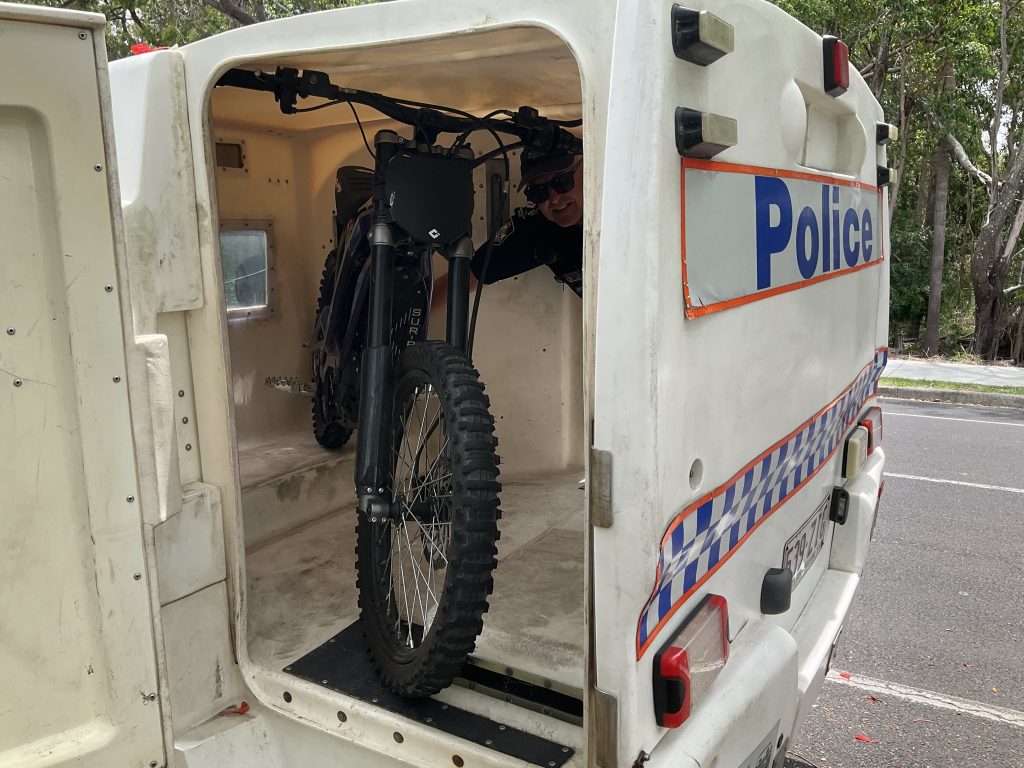
Additional recommendations include giving police the power to seize and impound illegal e-mobility devices on a first offence, including the ability to dispose of or destroy a device. Parents and guardians would be liable for penalties when children under 16 breach e-mobility regulations. Riders would also be subject to the same alcohol and drug rules that apply to other road users.
On infrastructure, the inquiry recommends embedding e-mobility into strategic transport planning through high-quality, connected and separated pathway networks, and a community safety campaign rollout for riders, drivers and the broader community.
AMA Queensland’s Response
AMA Queensland, based at Kelvin Grove, made a formal submission to the inquiry in June 2025 and appeared at hearings in August last year. The organisation had been advocating for an under-16 ban well before the report’s release, writing to transport authorities in November 2025 urging action ahead of the inquiry’s findings.
AMA Queensland president Dr Nick Yim said the recommended age restriction was a sensible and responsible outcome. He noted that 16 is the age at which Queenslanders begin learning to drive, acquiring road rules knowledge and developing the awareness needed to share roads safely. Yim said emergency doctors had treated significant injuries in paediatric and adolescent patients whose consequences extended beyond the individuals to their families, friends and treating clinicians over the long term.
Yim also welcomed the recommended speed reclassification threshold, the alcohol and drug rules alignment and the infrastructure recommendations. AMA Queensland has advocated for active travel infrastructure improvements, particularly around schools, parks and hospitals, and sees e-mobility as having a genuine role in affordable transport access, physical activity and emissions reduction — provided it operates within a safe regulatory framework.
Bicycle Queensland chief executive Matt Burke supported the age restriction but raised concerns about the licence requirement, arguing it was without precedent internationally and would significantly affect food delivery riders and tourists using hire schemes.
Why These Restrictions Benefit the Paddington and Kelvin Grove Community
The Paddington and Kelvin Grove area sits within a dense inner-Brisbane corridor where e-scooters and e-bikes share footpaths, bike lanes and roads with pedestrians, cyclists and school students. The proposed restrictions address the specific conditions that produce the most serious injuries: young riders without road rules training, devices travelling at speeds incompatible with shared path use, and no enforceable consequence for illegal devices.
A footpath speed limit of 10km/h, combined with the reclassification of high-powered devices as motorcycles, directly reduces the risk to pedestrians on the busy shared paths that run through Paddington, Kelvin Grove and the surrounding inner west. The licence requirement, if adopted, ensures that riders on local streets have at minimum completed Queensland’s online road rules programme before operating a device in traffic.
For families in the area, the parental liability provisions mean that the consequences of a child riding illegally extend to adults in a position to prevent it — creating a practical incentive for households to understand and follow the new rules. For the broader community, reinvestment in dedicated cycleways and separated pathways, as recommended by the inquiry, would reduce the conflict points between e-mobility users and pedestrians that currently make shared paths hazardous.
What Happens Next
The recommendations are not yet law. The report has been tabled and is under review, with implementation of paid parking and resident permits possible in late 2026 and into 2027 subject to that process. The full report and its 28 recommendations are available through the Queensland Parliament website. AMA Queensland’s statement on the report is available here.
The search for a missing Kelvin Grove cybersecurity worker has taken a disturbing turn, with police charging two men with torture as investigations continue across multiple locations in Queensland.
Andrew Burow, 56, vanished from his Lorimer Terrace home on August 20, though his disappearance wasn’t reported to police until four days later on August 24. The father and cybersecurity professional has been living in the inner-Brisbane suburb for nine years, close to the Queensland University of Technology campus.
Police have now charged 38-year-old Anthony Perrett and 26-year-old Billy Howard with torture in connection with Mr Burow’s disappearance. Both men faced Maroochydore Magistrates Court earlier this week, with proceedings adjourned.
The investigation has rapidly expanded beyond Brisbane, with Queensland Police establishing an incident centre under Operation Veer. Crime scenes have been declared at multiple properties, including Mr Burow’s Kelvin Grove home and locations on the Sunshine Coast.
Forensic teams have been conducting extensive searches at a Kokoda Avenue property in Bli Bli, with neighbours reporting concerning observations. Local residents recalled seeing a fire burning at the property early Tuesday morning that appeared unusually dark and carried the smell of chemicals.
The investigation has extended to rural areas, with additional crime scenes declared at Black Pinch Road in Pomona and Kamala Drive in nearby Lake MacDonald, both locations inland from Noosa.
Detective Acting Superintendent Craig Williams confirmed police are working around the clock to locate Mr Burow. According to police sources cited by Queensland Police, the disappearance is considered completely out of character for the 56-year-old, prompting serious concerns from both investigators and family members.
Mr Burow works as a cybersecurity manager and has extensive experience as a project manager across various companies, holding qualifications in IT and management. Property records show he owns multiple properties in the Brisbane area.
Before his disappearance, Mr Burow had contacted a real estate agent about potentially selling his house, though the significance of this action remains unclear in the investigation.
Friends who spoke to media outlets described Mr Burow as genuinely friendly and someone who cared deeply about people. They expressed hope he would be found safe.
A neighbour in Kelvin Grove told media she found it concerning that she hadn’t seen Mr Burow around recently, noting the family she lives with also hadn’t heard anything.
Police describe Mr Burow as Caucasian with a fair complexion, sandy to reddish hair, and bluish-green eyes.
Brisbane Region Crime Coordinator Detective Acting Superintendent Craig Williams emphasised the thoroughness of the investigation, with officers remaining committed to working continuously until Mr Burow is located.
The Kelvin Grove community, known for its proximity to QUT and mix of students and long-term residents, has been following developments closely as the investigation unfolds.
Queensland Ballet is offering free weekly ballet classes for boys in a bid to boost male participation in the artform and challenge lingering stereotypes.
The Ballet Boys Project, open to boys aged 11 to 14, runs at Queensland Ballet’s West End studios and the Academy at Kelvin Grove. The second semester of the boys-only program began on 16 July 2025. No fees, uniforms or auditions are required, with organisers aiming to remove barriers that may stop boys from trying ballet.
Photo credit: Queensland Ballet
Students who join the classes train with professional male teachers, focus on male-specific ballet technique, and practise in purpose-built studios. The boys-only format also gives them the chance to build friendships with peers, many of whom were previously the only male in their local ballet schools.
For 12-year-old Lucas, one of the students, the classes began as a way to improve his hip hop but quickly turned into a genuine love for ballet. Alfred, 13, who once danced as the only boy in his town’s school, said it has been a welcome change to learn alongside others his age and to pick up skills from them as well.
Photo credit: Queensland Ballet
Beyond dance skills, the program is designed to support physical and personal development. Boys gain strength, flexibility, and coordination that can complement other sports, while also building resilience and confidence. The mentoring from experienced male dancers helps them see ballet as a pathway that values athleticism as much as artistry.
Queensland Ballet says the initiative is part of a wider effort to address the global decline in male dancers, which it sees as a sustainability issue for the artform. By making ballet more accessible, the company hopes to ensure stronger participation from boys and men in the years ahead.
Some students take part to improve coordination and fitness for other sports, while others are pursuing ballet more seriously. Across the board, participants are benefiting from the focus on strength, power and athleticism — qualities that highlight ballet as a discipline demanding as much rigour as any sport.