

Kelvin Grove Biotech Uses AI-Grown Human Tissue to Reduce Animal Testing

Gelomics, a biotech company headquartered in Kelvin Grove, has built an AI-powered platform that grows functional human tissue models in the lab, giving pharmaceutical researchers an alternative to animal experiments during early-stage drug development.


The company shares its address with the Queensland University of Technology’s Centre for Biomedical Technologies, a fitting overlap given that Gelomics founder and CEO Dr Christoph Meinert developed the underlying science while completing his PhD in regenerative medicine at the same university.

Founded in 2018, the company has grown from a university research idea into a platform now used by around 250 research laboratories across 23 countries, including Australia, New Zealand, Singapore, the United States, Japan and several European nations.

The challenge facing drug development

The problem Gelomics set out to solve is a well-documented one in pharmaceutical research. More than 90 per cent of drug candidates that pass years of animal testing still fail once they reach human clinical trials, a gap that reflects just how differently animal and human biology can respond to the same compound.

Photo Credit: Gelomics

“The issue is that these models don’t translate well to human biology. For example, results from mouse studies rarely correlate with human outcomes,” Meinert said. “Instead of testing drugs and compounds in animals, we can actually generate tissues that look, feel and behave and react to drugs just like real human tissues in the lab.”

Around 200 million animals are used globally each year for pharmaceutical research, a figure Meinert points to directly when describing the company’s purpose. “At a high level, success means a reduction in unnecessary animal testing. That’s a core part of our mission.”

From four hours to ten minutes

Gelomics’ platform, built around its LunaGel photocrosslinkable tissue culture system, takes human cells, including stem cells or patient-derived cancer cells, and embeds them in a hydrogel that mimics the protein environment of real human tissue. The cells then grow and organise into tissue-like structures resembling miniature functional organs, from beating cardiac tissue through to liver structures.

Photo Credit: Gelomics

What used to take roughly four hours to produce manually can now be completed in about 10 minutes, thanks to an integrated laboratory device using photocuring technology to rapidly form the gel with precise mechanical properties.

Researchers begin by planning experiments through a cloud-based system, where a deep-research AI agent summarises the current state of a given research field and identifies relevant literature before generating a full experimental protocol.

Pharmaceutical companies working with Gelomics have reported an estimated 15 per cent reduction in their animal testing requirements, alongside cost reductions of around 20 per cent, according to Meinert.

The Brisbane partnership behind the scale-up

Gelomics’ growth from a working lab prototype into a globally distributed platform was supported through a collaboration with ARM Hub, the Queensland-based AI and advanced manufacturing organisation, delivered through its AI Adopt Centre. The engagement was funded through two ARM Hub accelerators backed by the Australian Government’s $17 million AI Adopt Program.

Photo Credit: Gelomics

ARM Hub Founder and CEO Professor Cori Stewart said the partnership filled a specific gap. “Christoph and the Gelomics team had the science working in the lab,” she said. “What they needed was secure cloud infrastructure that would give pharmaceutical clients confidence their data was protected. We worked with them to build that foundation, which opened the door to a Google accelerator and a path to scaling globally.”

Stewart frames Gelomics as a case study in capturing value locally rather than exporting Australian-developed intellectual property for someone else to commercialise. “Pharma companies need better tools for testing, regulators are pushing them toward lab-grown models, and Australia has the research talent to build those tools,” she said.

ARM Hub Chief Commercial Officer Sam Jesudian pointed to the practical infrastructure challenge underpinning the science. “To demonstrate the capabilities of NAM technologies, large datasets and live-cell imaging data are needed to validate through sensor-and-image-based systems, and that requires the right infrastructure,” he said.

Regulators are paying attention too

Gelomics’ work sits within the growing field known as New Approach Methodologies, or NAMs, non-animal testing tools that regulators worldwide are increasingly encouraging as part of drug approval pathways. For NAMs to gain wider acceptance, they need robust data and computing systems behind them to support regulatory decision-making, which is precisely where the cloud infrastructure built through the ARM Hub partnership becomes relevant.

Since launching in 2018, Brisbane biotech Gelomics has secured a $2.2 million pre-seed round backed by Jelix Ventures, the Queensland Investment Corporation and AngelLoop. Paired with recent federal commercialisation grants, the capital injection pushes the startup’s total funding well past the $3 million mark

The company was named winner of KPMG’s national Tech Innovator award, recognition that reflects how far the platform has travelled from its origins in a QUT PhD project to a tool now relied upon by research institutions from Harvard to Oxford.

For more information on Gelomics and its LunaGel platform, click here.


Published 17-June-2026

Queensland Parliamentary Inquiry Recommends New Restrictions on E-Bikes and E-Scooters

A parliamentary inquiry into e-mobility safety has recommended that riders under 16 be banned from operating e-bikes and e-scooters in Queensland, that all riders hold at least a learner’s licence, and that devices capable of exceeding 25km/h be reclassified as motorcycles — recommendations that AMA Queensland, whose head office sits in Kelvin Grove, has formally welcomed as measures that will save lives.


The inquiry, tasked in May last year with investigating safety issues including increasing crashes, injuries and fatalities, released its report in early March 2026 containing 28 recommendations across safety, lithium-ion battery fire risk, retail of devices, enforcement and community education. The recommendations represent what the inquiry described as a new national standard for the management of e-scooters and e-bikes.

What Prompted the Inquiry

The scale of the problem drove the inquiry’s formation. In 2025, 12 Queenslanders died in e-mobility-related incidents, including children, and more than 6,300 people presented to emergency departments with injuries. AMA Queensland described most of those incidents as likely preventable.

The human cost of the current regulatory environment is reflected in the inquiry report itself, which personally names eight-year-old Zeke Hondow, who died in October 2025 after being struck by a high-powered e-motorcycle while riding home from school on the Sunshine Coast. His mother Kloe Weedon began advocating for age limits within weeks of his death and welcomed the report’s recommendations, describing the proposed changes as significant and expressing hope they would be adopted swiftly.

The 28 Recommendations at a Glance

The inquiry’s central recommendation is that e-bikes and personal mobility devices be restricted to riders aged 16 and over. Alongside the age restriction, all riders would be required to hold at least a Queensland Class C learner licence, which requires completion of an online learning programme. The age and licence requirements would not apply to e-wheelchair users.

Inquiry on new restrictions for e-mobility devices
Photo Credit: Andrew Quilty

On speed, the inquiry recommends reducing the footpath speed limit for all e-mobility devices to 10km/h. Devices with a top speed above 25km/h would be reclassified as motorcycles or mopeds, requiring riders to hold an appropriate driver’s licence, the vehicle to be registered, and use restricted to roads only. The inquiry also recommends that all e-mobility devices with an electrical power source be defined as motor vehicles under legislation, simplifying enforcement.

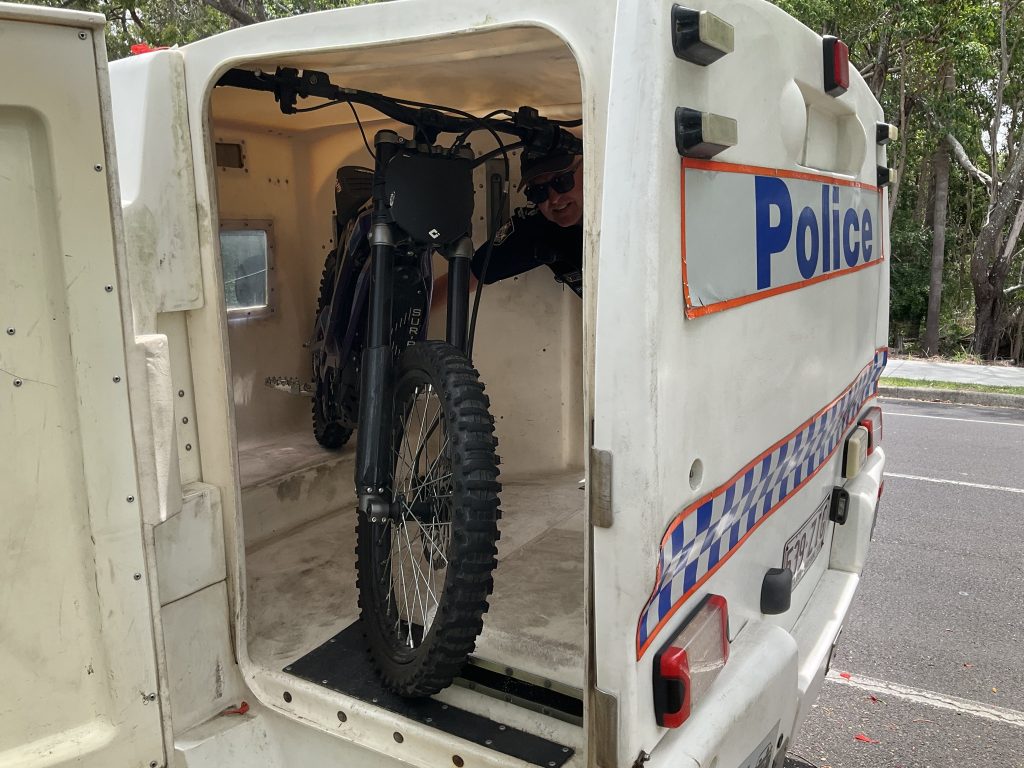
Additional recommendations include giving police the power to seize and impound illegal e-mobility devices on a first offence, including the ability to dispose of or destroy a device. Parents and guardians would be liable for penalties when children under 16 breach e-mobility regulations. Riders would also be subject to the same alcohol and drug rules that apply to other road users.

On infrastructure, the inquiry recommends embedding e-mobility into strategic transport planning through high-quality, connected and separated pathway networks, and a community safety campaign rollout for riders, drivers and the broader community.

AMA Queensland’s Response

AMA Queensland, based at Kelvin Grove, made a formal submission to the inquiry in June 2025 and appeared at hearings in August last year. The organisation had been advocating for an under-16 ban well before the report’s release, writing to transport authorities in November 2025 urging action ahead of the inquiry’s findings.

AMA Queensland president Dr Nick Yim said the recommended age restriction was a sensible and responsible outcome. He noted that 16 is the age at which Queenslanders begin learning to drive, acquiring road rules knowledge and developing the awareness needed to share roads safely. Yim said emergency doctors had treated significant injuries in paediatric and adolescent patients whose consequences extended beyond the individuals to their families, friends and treating clinicians over the long term.

Yim also welcomed the recommended speed reclassification threshold, the alcohol and drug rules alignment and the infrastructure recommendations. AMA Queensland has advocated for active travel infrastructure improvements, particularly around schools, parks and hospitals, and sees e-mobility as having a genuine role in affordable transport access, physical activity and emissions reduction — provided it operates within a safe regulatory framework.

Bicycle Queensland chief executive Matt Burke supported the age restriction but raised concerns about the licence requirement, arguing it was without precedent internationally and would significantly affect food delivery riders and tourists using hire schemes.

Why These Restrictions Benefit the Paddington and Kelvin Grove Community

The Paddington and Kelvin Grove area sits within a dense inner-Brisbane corridor where e-scooters and e-bikes share footpaths, bike lanes and roads with pedestrians, cyclists and school students. The proposed restrictions address the specific conditions that produce the most serious injuries: young riders without road rules training, devices travelling at speeds incompatible with shared path use, and no enforceable consequence for illegal devices.

Photo Credit: mPGC / Facebook

A footpath speed limit of 10km/h, combined with the reclassification of high-powered devices as motorcycles, directly reduces the risk to pedestrians on the busy shared paths that run through Paddington, Kelvin Grove and the surrounding inner west. The licence requirement, if adopted, ensures that riders on local streets have at minimum completed Queensland’s online road rules programme before operating a device in traffic.

For families in the area, the parental liability provisions mean that the consequences of a child riding illegally extend to adults in a position to prevent it — creating a practical incentive for households to understand and follow the new rules. For the broader community, reinvestment in dedicated cycleways and separated pathways, as recommended by the inquiry, would reduce the conflict points between e-mobility users and pedestrians that currently make shared paths hazardous.

What Happens Next

The recommendations are not yet law. The report has been tabled and is under review, with implementation of paid parking and resident permits possible in late 2026 and into 2027 subject to that process. The full report and its 28 recommendations are available through the Queensland Parliament website. AMA Queensland’s statement on the report is available here.


Published 6-March-2026.

Kelvin Grove State College Joins Elite in 2023 School Rankings

Kelvin Grove State College has emerged as a rising star in Queensland’s educational landscape, securing a spot among the top 50 high schools in the state, according to the latest rankings by Better Education.


The independent specialist schools website, Better Education, recently unveiled its updated list of Queensland’s top 150 schools for Years 7–10. This compilation ranks public and private institutions based on their Year 9 English and Math test results in 2023.

While the top four schools remained unchanged from the previous year, Northside Christian College made a significant leap forward, joining a select group of institutions that have substantially improved their standing. This achievement places Northside among the most improved schools across the state, reflecting its commitment to academic excellence and holistic student development.

Kelvin Grove State College

It was established in 2002 through the amalgamation of Kelvin Grove State High School and Kelvin Grove State School, as part of the Queensland government’s Smart State initiative. This merger transformed the school into a P-12 institution, catering to students from preparatory through year 12.

The school’s history dates back further than its official establishment in 2002. The original Kelvin Grove State School was opened in 1924, while Kelvin Grove State High School was established in 1950. These institutions served the local community for decades before their merger into the current Kelvin Grove State College.

Kelvin Grove State College has a rich history and continues to be a leading educational institution in Queensland. Its focus on innovation, technology, and collaboration with QUT positions it as a forward-thinking institution preparing students for the future.

The 2023 rankings also saw several other noteworthy improvements, particularly among private schools outside of Brisbane. Annandale Christian College in Townsville, St Luke’s Anglican School in Bundaberg, and Tamborine Mountain State High School in the Scenic Rim all made substantial gains, showcasing the growing strength of educational institutions in regional areas.

Other notable climbers included Immanuel Lutheran College on the Sunshine Coast, Springfield Anglican College in Ipswich, and St Andrew’s Lutheran College on the Gold Coast. These schools’ advancements highlight the dynamic nature of education in Queensland and the dedication of educators across the state to continually enhance learning outcomes for their students.

RankSchoolLocalitySectorState Overall Score2022 Rank
1Queensland Academy for Science, Mathematics and TechnologyToowongGovernment1001
2Brisbane Grammar SchoolBrisbaneNon-Government1002
3Brisbane Girls Grammar SchoolBrisbaneNon-Government1003
4Brisbane State High SchoolSouth BrisbaneGovernment1004
5Somerville HouseSouth BrisbaneNon-Government1009
6St Peters Lutheran CollegeIndooroopillyNon-Government10010
7Somerset CollegeMudgeerabaNon-Government1005
8Ormiston CollegeOrmistonNon-Government1006
9St Joseph’s College Gregory TerraceBrisbaneNon-Government9911
10Cannon Hill Anglican CollegeCannon HillNon-Government9913
11Whitsunday Anglican SchoolBeaconsfieldNon-Government997
12Anglican Church Grammar School (Churchie)East BrisbaneNon-Government9915
13AB Paterson CollegeArundelNon-Government9922
14St Aidan’s Anglican Girls’ SchoolCorindaNon-Government998
15All Hallows SchoolBrisbaneNon-Government9916
16Emmanuel CollegeCarraraNon-Government9924
17St Margaret’s Anglican Girls SchoolAscotNon-Government9914
18Ipswich Grammar SchoolIpswichNon-Government9912
19Redeemer Lutheran CollegeRochedaleNon-Government9921
20Matthew Flinders Anglican CollegeBuderimNon-Government9919
21All Saints Anglican SchoolMerrimacNon-Government9917
22Hillbrook Anglican SchoolEnoggeraNon-Government9927
23Mansfield State High SchoolMansfieldGovernment9929
24Citipointe Christian CollegeCarindaleNon-Government9834
25Brisbane Boys’ CollegeToowongNon-Government9818
26Sheldon CollegeSheldonNon-Government9823
27John Paul CollegeDaisy HillNon-Government9831
28Indooroopilly State High SchoolIndooroopillyGovernment9835
29Sunshine Coast Grammar SchoolForest GlenNon-Government9845
30Mt St Michael’s CollegeAshgroveNon-Government9825
31St Rita’s CollegeClayfieldNon-Government9828
32Northside Christian CollegeEverton ParkNon-Government9820
33Immanuel Lutheran CollegeBuderimNon-Government9869
34Annandale Christian CollegeAnnandaleNon-Government9874
35Loreto CollegeCoorparooNon-Government9839
36Stuartholme SchoolToowongNon-Government9844
37Ipswich Girls’ Grammar SchoolEast IpswichNon-Government9833
38Padua CollegeKedronNon-Government98New Entry
39St Andrew’s Anglican CollegePeregian SpringsNon-Government9847
40Moreton Bay CollegeManly WestNon-Government9752
41Marist College AshgroveAshgroveNon-Government9732
42Kelvin Grove State CollegeKelvin GroveGovernment9748
43Trinity Anglican SchoolWhite RockNon-Government9740
44Brisbane South Secondary CollegeDutton ParkGovernment97New Entry
45St John’s Anglican CollegeForest LakeNon-Government9757
46Mount Alvernia CollegeKedronNon-Government9741
47Cavendish Road State High SchoolHolland ParkGovernment9746
48Moreton Bay Boys CollegeManly WestNon-Government9762
49Townsville Grammar SchoolNorth WardNon-Government9726
50Villanova CollegeCoorparooNon-Government9760

Overall, the 2023 Better Education rankings paint a picture of a thriving educational landscape in Queensland, with schools across the state striving for excellence and achieving impressive results. The impressive advancements made by Northside Christian College and other organisations serve as both an example and a testament to the transformative power of education.

Published Date 10-June-2024