


Roosters Blow It Open, Broncos Bring It Back — But Not Quite Enough

For 50 minutes, it was a blowout. For the next 30, it was chaos. And somewhere in between, the Brisbane Broncos nearly pulled off something the NRL has never seen.


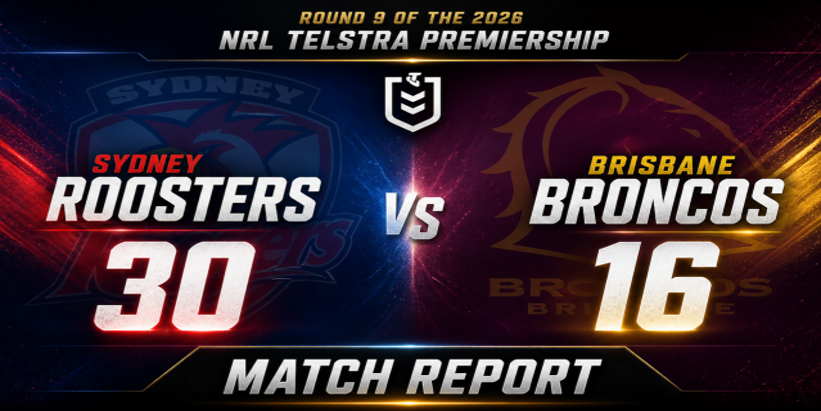
In Round 9 of the 2026 NRL Telstra Premiership at Allianz Stadium, Brisbane stared down a 30–0 deficit, without Adam Reynolds, and surged to within a converted try — only for it to slip away in a 38–24 loss to the Sydney Roosters.

Blown off the park early

The warning signs were there from the opening set.

Sydney’s middle rolled forward at will, James Tedesco probed relentlessly around the ruck, and Brisbane were immediately on the back foot. The Roosters didn’t just score first — they dictated everything.

A sharp dart from dummy-half opened the door for the opener, and it didn’t slow from there. Tupou finished slick left-edge movement. Walker’s boot and bounce-of-the-ball luck summed up the half. By the break, it was 24–0 and felt worse.

Every Brisbane set looked like survival. Every Roosters set looked like points.

When Nat Butcher crashed over early in the second half — Reynolds left groggy in the same passage — it hit 30–0 and the contest felt done.

Then Walsh lit the fuse

Reece Walsh changed the game in a flash.

Out of dummy-half, he sliced through for Brisbane’s first. It wasn’t just the try — it was the tempo shift. Suddenly the Roosters were retreating, and Brisbane were playing fast.

Xavier Willison crashed over. Then the Broncos went length-of-the-field, finished by Pat Carrigan. The noise changed. The body language changed.

At 30–18, belief crept in.

Then came the moment — Walsh again, squaring the line and releasing Jordan Riki into space. Try. Conversion. 30–24.

From nowhere, it was a six-point game with 13 minutes to play.

The swing that killed it

Momentum had flipped. The Roosters were rattled.

Then came the errors.

A Carrigan mistake halted a crucial attacking set. Moments later, Kotoni Staggs was sin-binned for a raised elbow — a split-second lapse that changed everything.

Against 12 men, the Roosters steadied.

They took the points when needed, then struck late through Reece Robson to put it beyond reach. The scoreboard stretched back out, but it didn’t tell the full story of what Brisbane had just threatened to do.

What it says about Brisbane

This wasn’t just a loss.

It was two very different performances stitched into one night — a passive, overwhelmed opening hour, followed by a fearless, high-tempo surge that had a heavyweight opponent scrambling.

Walsh’s influence was electric. Carrigan and the pack found their punch late. The shapes clicked when the speed lifted.

But the margin between almost and done is still discipline.

Errors. A sin bin. Lost moments.

Against elite sides, that’s the difference.

Close enough to feel it

They were gone. Then they weren’t. Then it was over.

And that’s the frustration — because for 15 minutes, Brisbane didn’t just compete with one of the form teams in the competition.

They had them.


Published 2-May-2026

The Red Hill Salon That Just Became Australia’s Best

Fruition Hair, with its Red Hill salon has been named Australian Salon of the Year at the 2026 Australian Hair Fashion Awards, held on 19 April at Sydney Town Hall, claiming the night’s most prestigious business title against the best salons in the country.


The win did not come alone. Fruition stylist Louise Graham took Queensland Hairdresser of the Year at the same ceremony, and Helmet Hair Co., the Nundah salon founded by the same owner as Fruition, added Apprentice of the Year through Jake Pafumi.

Together, the three titles gave the Fruition group a sweep of Australia’s most respected industry awards spanning salon leadership, advanced styling and emerging talent in a single night.

Fruition was also represented in two further national finalist positions. Louise Graham earned a national finalist spot for Australian Creative Colourist of the Year, and Helmet Hair Co.’s Max Cooper was a finalist for Australian Hairdresser of the Year.

The Person Behind the Salons

Craig Smith has been a fixture in Brisbane’s hairdressing world since opening Fruition in the Brisbane CBD in 1996, relocating to Wilston in 2012 and later establishing the Red Hill salon to bring the Fruition experience closer to the inner-west community.

Photo Credit: Supplied

He is himself an AHFA Australian Hairdresser of the Year alumni, and has spent three decades building a group that pairs high-end technical work with genuine mentorship at every level.

Smith also co-owns Helmet Hair Co., the Nundah salon described on the Fruition website as “the cool, creative little sister/brother to Fruition,” grown from the same commitment to exceptional hair but with a bolder, more rebellious character. The fact that both brands contributed to the same awards night sweep reflects the depth and consistency Smith has cultivated across his group.

Fruition Red Hill, led day-to-day by salon director Chad Nicholson alongside Smith’s creative direction, is known for its elevated but unpretentious feel: expert craftsmanship, award-winning stylists and the kind of considered service that has kept a loyal client base coming back for years. Reviews consistently point to Louise Graham as one of the most trusted stylists in the building.

Chad Nicholson in Fruition Hair
Photo Credit: Fruition Hair/Facebook

“I have been going to Fruition Hair for years now and have always seen Louise,” one client noted. “She has completely transformed my hair into the hair I had when I was a child, thick, healthy and long. Louise is incredibly knowledgeable, caring and consistent, and you can truly tell she loves what she does.”

A Closer Look at Salon of the Year

The AHFA, which has been running since 1992, is judged by an international panel of industry experts and is the longest-running and most prestigious independent hairdressing awards programme in Australia and New Zealand. Salon of the Year does not recognise a single moment of creative work. It recognises how a business operates across every dimension: team development, client experience, culture, commercial performance and consistency over time.

Photo Credit: Fruition Hair/Facebook

Winning it places Fruition in the company of the most respected salon businesses Australia has produced. For a salon operating in Red Hill and Wilston rather than a major CBD flagship location, it is a result that says something clear about the standard being set on Musgrave Road.

Book and Find Out More

Fruition Red Hill is at 160 Musgrave Road, Red Hill, phone (07) 3506 0216. Fruition Wilston is at Shop 1, 2 Heather Street, Wilston, phone (07) 3356 3311. Bookings and information can be viewed here, or follow the salon on Instagram.


Published 26-April-2026

Broncos Bash Bulldogs 32–12 in Statement Win Amid Injury Crisis

They came in undermanned. They left unquestioned.

Missing 13 regulars and facing a Canterbury side with momentum, the Brisbane Broncos flipped the script early and never let it swing back, powering to a commanding 32–12 win in Round 8 of the 2026 Telstra Premiership at Suncorp Stadium.

The Pre-Anzac Day battle was setup beautifully with the poignant Anzac pre match ceremony.

Round 8 Highlights of Broncos vs Bulldogs game

From the outset, Brisbane were clear in approach. Composed, direct, and defensively tight, they absorbed early pressure as Canterbury probed the edges—twice shaping for an overlap on the right but failing to pull the trigger.

That hesitation proved costly.

In the 16th minute, Ezra Mam turned pressure into points. A low grubber skidded through the line, Marcelo Montoya misjudged it, and Gehamat Shibasaki pounced. Reynolds converted. 6–0.

Moments later, Brisbane struck again—this time with precision. Mam squared up the line and delivered a clean ball to Josiah Karapani, who cruised through untouched. Two visits, two tries. 10–0.

Territory without reward

The Bulldogs weren’t without chances. They spent extended sets inside Brisbane’s 20, but the final play kept breaking down—passes held, options missed, timing just off. Brisbane’s line speed did the rest, closing space before it could open.

Then came the swing.

At the 28th minute, Harry Hayes was sent to the bin for a trip, and the Broncos immediately capitalised. Reynolds pointed to the posts and stretched the lead to 12–0. It wasn’t just the points—it was the shift. The Bulldogs’ energy dipped, Brisbane’s lifted.

The pressure rolled on.

Deine Mariner produced one of the finishes of the night in the corner—tight space, full control—before turning provider minutes later. Bursting down the right edge, he drew the defence and found Cory Paix backing up inside. 20–0.

By halftime, the gap felt wider than the scoreboard. Brisbane had missed just five tackles despite the reshuffle, and Canterbury—despite their territory—had nothing to show for it.

Mam lights it up

Any hope of a Bulldogs reset after the break lasted barely five minutes.

A broken play turned into brilliance. The ball was batted loose, Mam reacted quickest, scooped it up and launched himself toward the corner—somehow grounding it while staying in play. It was instinct, balance, and confidence in one movement. Reynolds converted. 26–0.

At that point, it was no longer about who would win—but how the game would finish.

A flicker, but no shift

To their credit, the Bulldogs kept turning up.

Matt Burton finally broke through after a midfield surge, and later Lachlan Galvin sliced through off a well-timed lead run to narrow the margin. For a brief stretch, momentum tilted—but never fully turned.

Brisbane absorbed it again.

Even with disruption—Preston Riki sent to the bin and Brendan Piakura forced off—their defensive shape held. Reynolds slowed the game when needed, kicked long, and reset field position. The urgency from Canterbury never quite translated into sustained pressure.

Depth delivers

The final say belonged to Brisbane’s pack.

With Payne Haas absent, Xavier Willison stepped up across the night—and finished it late. Charging onto the ball near the line, he powered through to seal it. It was direct, physical, and symbolic of the performance.

Reynolds added the extras. 32–12.

This wasn’t about possession or territory. It was about execution—and Brisbane nailed the moments that mattered.

The Bulldogs had their chances and left them out there.

The Broncos didn’t.

Short-handed, under pressure, and still in control from start to finish—this wasn’t just a win.

It was a reminder. Count them out at your own risk.

Published 24-April-2026

Why Do Kids Fear School Toilets? Paddington Therapist Explains

Paddington occupational therapist Rebecca Khan has been seeing a pattern that often surprises parents. Children who can run, play and follow classroom routines are still refusing to use the school toilet.


Ms Khan, a senior occupational therapist and founder of Kids That Go, has spent years working with families dealing with toileting struggles. She has noticed more children arriving at school without the confidence to use public bathrooms, leading many to hold on until they get home.

Rebecca Khan
Photo Credit: Supplied

A daily struggle that follows children into the classroom

For many children, the school day includes a silent effort to ignore the body’s signals. Ms Khan has observed that some children are so used to holding on that they begin to lose their natural awareness of when they need to go.

This pattern is reflected in recent research commissioned by Kleenex Australia, which found that almost half of children aged three to eight have held in a bowel movement during the school day. A significant number also report feeling stressed or overwhelmed when faced with using a public toilet.

Teachers are noticing it too. Many report seeing children hesitate or avoid the bathroom several times a week, and in some cases, accidents occur after long periods of holding on. The issue is not limited to younger students, with primary school teachers also reporting similar behaviours.

School bathrooms can feel unfamiliar and confronting

The reasons are often simple, but powerful. School toilets can feel different from home. They may be noisier, less private, or harder to keep clean throughout the day.

Children also face social pressures. Some worry about being teased, while others are too focused on playtime or classroom activities to stop and go. For many, it comes down to feeling safe.

Parenting expert Genevieve Muir explains that children need to feel calm and secure before their body can relax enough to do a poo. When a child feels unsettled or rushed, the body tends to tense, making it harder to go.

“For many kids, this is simply about safety. Pooing is a biological process, and like sleep and eating, the body needs to feel calm and secure in order to do it. School is a different environment, and for some children, it takes time to feel comfortable enough.”

Parents feel stuck between concern and embarrassment

At home, parents are often left trying to manage the situation without clear answers. Many say their child refuses to use public toilets, even after toilet training has been completed.

Research shows a large number of parents are unsure how to build their child’s confidence in this area. Some feel uncomfortable raising the topic with other parents, while others worry about how accidents might be viewed at school.

This hesitation can make the issue harder to address. When conversations around toileting are avoided, children may pick up on that discomfort and feel the same way.

A children’s book aims to change the conversation

To help families navigate this stage, Kleenex has partnered with Jessica Rowe to create a children’s book called I Can’t Wait! My First School Poo.

The book, available through early learning centres, libraries and allied health services, uses simple storytelling to help children understand that going to the toilet at school is a normal part of growing up. It was developed with input from experts, including Genevieve Muir, to give parents and educators a shared way to talk about the topic.

The aim is to make these conversations feel ordinary rather than awkward. By using humour and familiar situations, the story encourages children to feel more at ease with their bodies.

Photo Credit: Supplied

Building confidence takes time and support

Ms Khan’s work in Paddington shows that most children move through this phase with the right support. Small steps, such as helping children feel connected and relaxed during the school day, can make a difference.

Over time, as children become more familiar with their environment and routines, their confidence tends to grow. For many families, the breakthrough comes unexpectedly, when a child finally feels ready and manages their first school bathroom visit.


The experience may not be widely discussed, but it is one shared by many. With more open conversations and practical support, both parents and educators are working towards making it a more comfortable part of childhood.

Published 24-April-2026

Viral Paddington Footage Raises Questions About Public Decency

An incident along Given Terrace in Paddington has sparked discussion after footage shared on X appeared to show a woman relieving herself in public.


Read: Paddington Mixed-Use Development Proposed for Latrobe and Given Terraces


The clip drew attention online, with users expressing a range of reactions in comments and posts. Some online comments criticised the behaviour, while others noted the footage shows only a brief moment without broader context.

The incident took place on Given Terrace, near a cafe, where it may have been visible to people nearby. The location has been noted in online discussions, given the area’s popularity as a dining and social hub.

The incident has prompted discussion online about behaviour in inner-city precincts. Paddington is known for its mix of hospitality venues and boutique retailers, attracting steady foot traffic throughout the day and into the evening. This level of activity can present challenges in managing behaviour in shared public spaces.

Footage
Photo credit: Google Street View

Online comments have raised issues including access to public amenities. In areas with active dining and nightlife scenes, limited availability of public toilets, particularly after hours, has long been raised as a concern. In some cases, a lack of facilities has been cited as a contributing factor in similar incidents.

Other comments emphasised personal responsibility. Some online responses stressed that shared public spaces should be treated with respect.

Some users also cautioned against rushing to judgement. Research from public health bodies indicates that behaviour in public spaces can sometimes be influenced by factors such as intoxication, illness, or urgency.

The incident has also drawn attention to nearby businesses. Small operators rely heavily on reputation and foot traffic, and even indirect associations with negative incidents can have an impact on how an area is perceived.

Public Urination Laws

In Queensland, public urination can fall under public nuisance offences. Police officers have the authority to issue infringement notices for behaviours such as disorderly or offensive conduct, offensive language, and public urination.

Officers may issue an infringement notice as an alternative to court proceedings. This approach allows police to manage incidents quickly while aiming to defuse situations and maintain public order.

Public urination is specifically listed among behaviours that can attract an infringement notice, alongside actions such as obstructing a police officer or failing to provide a correct name and address when requested. The use of discretion is a key part of enforcement, with officers expected to assess each situation based on its circumstances.


Read: QLD’s Largest Operational Police Station to Service CBD, Paddington, and Other Inner-city Suburbs


The incident has prompted discussion about balancing personal responsibility and practical urban considerations. The footage has also drawn attention to broader issues surrounding public behaviour. Some discussions have also focused on possible solutions, including public amenities and community expectations.

Published 17-April-2026

Petrie Terrace: Iconic Caxton Street Sites Enter Market in Rare Offering

Two adjoining commercial properties in Petrie Terrace have been brought to market, marking a rare opportunity within Brisbane’s well-established Caxton Street entertainment strip.


Rare Offering In Brisbane’s NRL Heartland

A tightly held section of Caxton Street in Petrie Terrace is entering a new phase, with 18–26 Caxton Street listed for sale after more than a decade. The offering brings together two adjoining freehold buildings positioned within one of the city’s most recognisable sporting and hospitality corridors.

Located approximately 160 metres from Suncorp Stadium, the site sits at the centre of a precinct long associated with major sporting events and high foot traffic. The strip continues to function as a focal point for pre- and post-event activity, alongside consistent trade as a food and beverage destination.

Caxton Street
Photo Credit: Colliers

Dual Buildings With Immediate Flexibility

The Petrie Terrace property comprises two connected buildings with a combined net lettable area of 512 square metres, complemented by external seating space. One tenancy is secured by a long-standing food operator with a lease in place, while the adjoining building is offered with vacant possession.

The larger structure spans four levels and includes an existing liquor licence, providing scope for immediate activation. The property is also fitted with commercial-grade infrastructure, including kitchen facilities, service systems, and multiple bar areas, supporting a range of hospitality or entertainment uses.

Additional features include a self-contained space that can function as an office or residential component, offering further flexibility for future operators or investors.

Brisbane property
Photo Credit: Colliers

Positioned For Continued Growth

The Petrie Terrace listing emerges amid ongoing investment activity across the Caxton Street precinct. Recent high-value transactions and new venue concepts have contributed to a broader shift, with the area evolving into a more expansive entertainment destination.

The site’s corner positioning provides strong exposure along Caxton Street, reinforced by a 24-metre frontage that enhances visibility and accessibility. Its zoning supports a mix of uses, aligning with the area’s established hospitality and leisure focus.

 commercial real estate
Photo Credit: Colliers

Limited Supply Driving Demand

Freehold opportunities of this scale remain limited within Petrie Terrace, particularly in locations with direct proximity to major event infrastructure. The combination of existing income, vacant space, and established foot traffic positions the property as a flexible asset suited to both owner-occupiers and investors.


Expressions of interest for the Petrie Terrace site are scheduled to close on May 21, reflecting the anticipated level of market interest in a precinct where availability remains constrained

Published 16-Apr-2026

QUT Eyes 2032 Role as Campuses Near Olympic Action


Queensland University of Technology (QUT) is aligning both its Gardens Point and Kelvin Grove campuses with Brisbane’s preparations for the 2032 Olympic and Paralympic Games, with a focus on campus upgrades, sport research and industry partnerships.


Campuses tied to growing Olympic precinct

QUT’s Kelvin Grove campus sits next to the planned Victoria Park Olympic stadium and National Aquatic Centre, placing it within what is expected to become a major sporting hub.

The university has indicated the wider Olympic and Paralympic precinct will link with the nearby Herston Health Precinct, forming a connected corridor for sport, health and biomedical research in Brisbane’s inner north.

Photo Credit: Google Maps


At the same time, its Gardens Point campus near the CBD and Fortitude Valley is positioned within the broader inner-city zone expected to see increased activity as the Games approach.

Campus changes planned over next decade

QUT has outlined a long-term master plan covering both campuses, designed to respond to growth linked to Brisbane 2032 and wider city development. The plan includes improving accessibility and safety, making campuses easier to navigate, and creating more flexible teaching and learning spaces. It also focuses on making research and innovation work more visible, allowing stronger links between students, industry and the community.

These changes are being planned alongside major developments such as the Victoria Park redevelopment and the expansion of surrounding health and knowledge precincts.

Facilities support sport and health focus

QUT already has a wide range of sport and health facilities across its campuses, including gyms, aquatic centres, indoor and outdoor courts, a FIFA-accredited field with a running track, and dedicated spaces such as an esports arena and virtual sport studio.

The university also operates health clinics in areas including exercise physiology, podiatry, nutrition, optometry and psychology, which support both student learning and community services.

These facilities are expected to play a role in supporting athlete preparation, research and participation in the lead-up to 2032.

QUT Sport tech van
Photo Credit: QUT

Student programs and innovation projects underway

QUT is running several programs that link students directly to sport and event-related work. Through its Sport Innovation ProtoComp, students work with industry mentors to develop solutions for real-world challenges in sport, including digital tools and performance systems.

The university has also developed projects focused on inclusive sport, including a virtual reality sports wheelchair simulator and an adaptive handcycle trainer that allows wheelchair users to take part in virtual cycling programs.

These initiatives bring together design, engineering, health and technology, reflecting the range of skills needed for large events like the Olympics.

QUT student athletes
Photo Credit: QUT

Global sport conference brings focus to Brisbane

QUT has already brought international expertise to Brisbane through its Future of Sport Conference, held at the Gardens Point campus in March. The event brought together leaders in sport, technology and research to examine how data, innovation and partnerships are shaping the future of sport ahead of the 2032 Games.

The university has indicated the conference reflects its role in linking research with practical outcomes as Queensland prepares for a series of major sporting events. Discussions covered areas such as performance analytics, athlete wellbeing, emerging technologies and the long-term sustainability of sport.

Researchers involved highlighted how data is increasingly used to improve training, reduce injury risk and support athlete wellbeing, with these approaches expected to expand in the lead-up to 2032.


Published 13-April-2026

QUT Unveils Plans for Kelvin Grove Campus Upgrade

Queensland University of Technology has unveiled a sweeping 25-year masterplan that would transform its Kelvin Grove campus into a mixed-use urban precinct of highrise towers, affordable housing for essential workers, on-site student accommodation and vibrant new public spaces — with the Olympic Games as a catalyst.


The 2026 to 2050 Campus Master Plan, released in March, is already generating real momentum. QUT moved quickly to launch an expressions of interest campaign for new student accommodation on an underused part of the Kelvin Grove site, even as the broader masterplan’s most ambitious changes remain years away from realisation.

Kelvin Grove is the main campus for QUT’s communication, creative industries, design, education, health and justice students, located in the thriving Kelvin Grove Village. The masterplan now positions the campus as far more than a university precinct, with residential, commercial and community functions woven through the site in a way that would make it one of Brisbane’s most significant urban villages.

A Campus That Grows Into Its Neighbourhood

The Kelvin Grove masterplan proposes a mixed-use highrise development at 5 Musk Avenue, combining commercial and residential spaces on a site that currently sits underutilised. The plan transforms Parer Place into a flexible outdoor space that doubles as a public plaza and events area, injecting new life into the heart of the campus. It introduces further residential towers within a central hub, while developers will deliver on-site affordable student accommodation at 95–107 Musk Avenue, bringing hundreds of students onto campus and supporting surrounding retailers.

QUT's master plan
Photo Credit: QUT

Perhaps the most significant proposal for the local community is the Parkside South precinct. Adjacent to the Victoria Park Olympic venues and within reach of a Brisbane Metro stop and the Royal Brisbane and Women’s Hospital, Parkside South would deliver a mix of market-rate and affordable housing specifically designed for essential workers, filling a gap in the local housing supply that has grown more acute as the suburb has become increasingly desirable.

The plan consolidates teaching spaces into northern and southern clusters to improve accessibility and efficiency, while new pedestrian connections link the campus more directly to surrounding parkland and the wider neighbourhood.

The Olympics Are Reshaping What’s Possible Here

The timing of the masterplan is deliberate. Kelvin Grove sits immediately adjacent to Victoria Park, the planned site for the proposed main Olympic stadium for Brisbane 2032, and QUT has designed the plan specifically to complement that transformation.

Photo Credit: QUT

“With the QUT Kelvin Grove campus neighbouring exciting development for Brisbane 2032, this plan complements the Victoria Park redevelopment and other city-shaping initiatives,” Vice-Chancellor Professor Margaret Sheil said.

The Brisbane Metro will connect the campus directly to Victoria Park and plays a central role in the plan’s vision for improved connectivity. Upgraded pathways will make the Creative Industries precinct easier to navigate, while planners will strengthen connections to the Royal Brisbane and Women’s Hospital to align with the broader suite of city-shaping projects underway.

A Plan for the Future

The Campus Master Plan reflects five years of engagement with staff, students, industry partners and the broader community, and positions the campuses as vibrant, collaborative hubs of innovation and creativity. For Kelvin Grove and Paddington residents, the changes represent a substantial evolution of their immediate neighbourhood, one that brings more people, more amenity and more connection to one of the fastest-changing parts of Brisbane.

Sheil framed the masterplan as a commitment to keeping QUT central to city life. “By aligning with Brisbane’s broader growth and development strategy, the Campus Master Plan ensures QUT remains accessible, future-ready and central to the city’s economic, social and cultural life,” she said.

Enquiries about the masterplan can be directed to masterplan@qut.edu.au. The full document is available to download here.


Published 13-April-2026

Paddington Mixed-Use Development Proposed for Latrobe and Given Terraces

A five-storey mixed-use development has been proposed in Paddington, outlining new apartments and retail spaces at a key corner of Latrobe and Given terraces.


Corner Site in Paddington Targeted for Redevelopment

A development application has been lodged for a mixed-use project at 2–8 Latrobe Terrace and 299 Given Terrace, covering a 1,822 square metre site about 3km from the Brisbane CBD. The proposal centres on a five-storey building with 29 apartments above ground-floor retail, office and indoor recreation spaces, positioned to activate both street frontages.

mixed-use Paddington
Photo Credit: DA/A006992438

The existing site, which includes an open car park and commercial tenancies, is intended to be cleared to enable redevelopment. The residential component comprises a mix of two- and three-bedroom apartments, including configurations with multipurpose rooms. Basement levels are planned to accommodate car parking and bicycle storage.

Design Reflects Established Paddington Streetscape

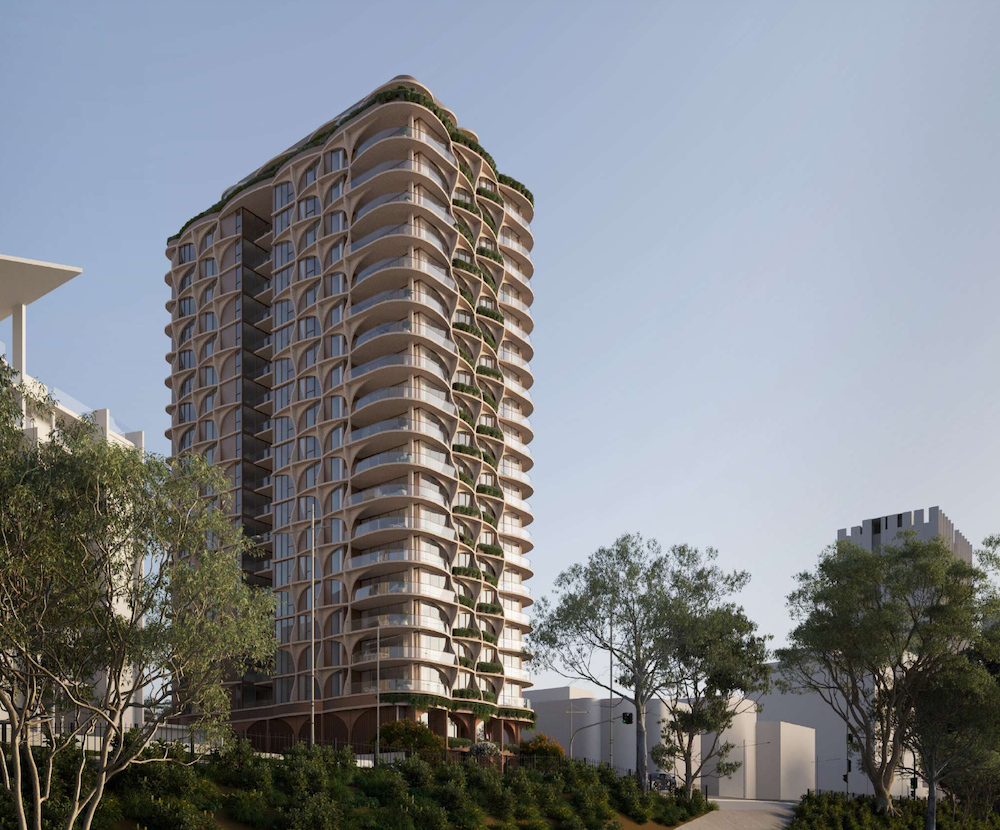
The architectural scheme has been prepared by SJB and draws on Paddington’s established character through the use of brick, timber detailing and verandah-style elements. The design incorporates recessed balconies, articulated forms and integrated planting to align with the surrounding built environment.

Brisbane apartments
Photo Credit: DA/A006992438

Subtropical design principles are incorporated through building orientation, natural ventilation and shading features. Sustainability measures include north-facing rooftop solar panels, water management systems and greenery integrated across multiple levels. Landscaping is proposed throughout the building, including podium areas and upper levels, to support amenity and visual integration within the precinct.

Retail Activation and Shared Rooftop Spaces

At ground level, the development introduces a mix of retail, office and indoor recreation uses designed to maintain active frontages along Latrobe and Given terraces. The corner positioning allows for continuous engagement with the street, supporting the function of the area as a local centre.

Paddington development
Photo Credit: DA/A006992438

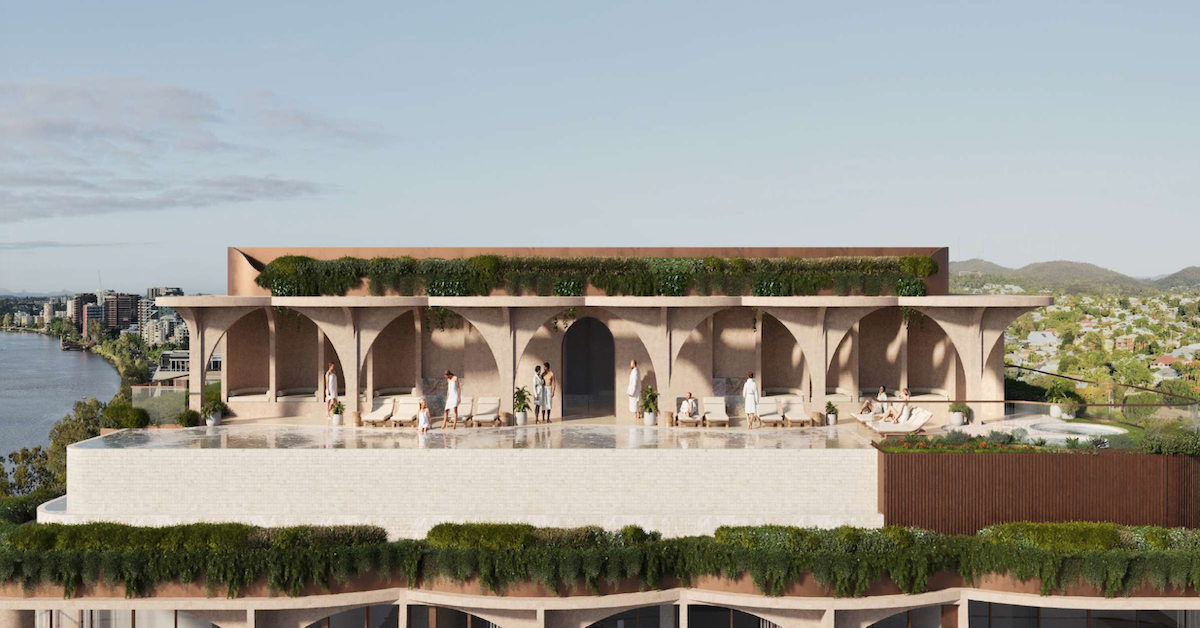
Residents would have access to a range of shared rooftop amenities, including a swimming pool, gym, sauna, yoga lawn, lounge and dining areas, barbecue facilities and a dedicated dog wash area. The rooftop is designed as a landscaped communal space with integrated planting.


The Paddington proposal forms part of ongoing activity within the precinct, where recent projects have combined residential uses with upgraded retail and public-facing spaces along Given Terrace.

Published 6-Apr-2026

The CBus Shakedown: Why Brisbane’s Blood-and-Guts Derby Win Proves They’re the Real Deal

The atmosphere at a sold-out CBus Super Stadium for the Round 5 local derby was nothing short of electric, the kind of humid, high-stakes evening where reputations are either forged or forgotten.

For the Brisbane Broncos, it began in “flying style,” with the kind of clinical precision we’ve come to expect when our superstars are in the mood.

Yet, what started as a celebration of Reece Walsh’s 100th NRL appearance rapidly descended into a survival test that would push our depth to its absolute limit.

By the time the halftime siren for Round 5 of the 2026 Telstra Premiership echoed across the Gold Coast, the mood amongst the Brisbane faithful had shifted from jubilation to genuine anxiety. The Broncos held a slender 8-6 lead, but the cost was staggering: half the team’s “spine” was gone.

Captain Adam Reynolds and the mercurial Walsh were both out of the equation before the second half even began. What followed, however, was a masterclass in resilience.

Brisbane transformed a looming disaster into a dominant 26-12 victory, proving that this squad’s premiership credentials are built on far more than just individual brilliance.

The Century of Brilliance and Brutality: Walsh’s Bitter-Sweet Milestone

Reece Walsh’s milestone match was a frantic microcosm of his career—a blend of breathtaking creative genius and a willingness to put his body on the line.

He ignited the contest in the third minute, soaring to snatch his own bomb out of Keano Kini’s grasp for a sensational try.

Throughout the first half, he looked untouchable; he tore through for a 70-metre individual burst that was only halted by a desperate, last-ditch cover tackle from the Titans’ PNG forward Cooper Bai, and later produced a 90-metre dash that was only denied by the narrowest of margins as his boot grazed the sideline.

But the brilliance was cut short by the sheer brutality of the modern game. Attempting to stop a charging Kurtis Morrin just before the break, Walsh was concussed.

The fallout is significant: a Category 1 HIA and a fractured cheekbone that requires immediate surgery, leaving us without our X-factor for the next four to six weeks. As he left the field, the Brisbane attack momentarily looked like it was wading through quicksand, struggling to find a rhythm without its primary spark plug.

Ezra Mam: Stepping Out of the Shadows

When Adam Reynolds succumbed to a groin injury in the 25th minute, the keys to the kingdom were handed to Ezra Mam earlier than anyone had anticipated. While the veteran skipper eventually returned to the sidelines to provide a “captain’s presence” from the bench, the on-field leadership fell to Mam.

It was a performance of pure character. Mam had a difficult moment in the first half, dropping a ball under a heavy Mo Fotuaika tackle that allowed Jojo Fifita to race away and score.

However, champions are defined by how they respond to such errors. In the second half, Mam was the definitive “difference.” He was the architect of the revival, providing the crucial assists for Xavier Willison and Gehamat Shibasaki as we broke the game open.

He eventually iced the result with a piece of solo magic, selling a massive dummy from dummy half to scoot through and score. It wasn’t just his attack, either; his 15th-minute try-saver on Arama Hau when the game was still on a knife-edge proved he is now a complete two-way footballer.

The Contentious Turning Point: 47 Minutes in and a “Fair Try” Denied

Derbies are won and lost on moments of high drama, and the 47th minute provided the night’s most controversial talking point. Gold Coast centre AJ Brimson appeared to have “iced” a fair try that would have reduced the gap to a single possession, potentially turning the match into a shootout.

However, touch judge Jarrod Cole flagged a forward pass from Lachlan Ilias, a call that left the Titans fuming. While the decision was “rough,” our boys showed the killer instinct required of contenders, scoring on the very next set to effectively break the Titans’ spirits.

Titans coach Josh Hannay’s frustration was palpable in the post-match: “It is a hard game and when you earn your opportunity and ice it, and it gets taken away, it is frustrating for the players.”

Tactical Versatility: The “Next Man Up” Mentality

The true story of this win lies in the “Next Man Up” mentality that permeated the reshuffled line-up.

When Reynolds exited, Ben Hunt didn’t just step into the halfback role; he did so while battling through the pain of a suspected medial injury.

Seeing Hunt in the dressing sheds later with ice strapped to his right knee only underscored the grit of his performance—it was his perfectly weighted bomb that initiated the sequence for our first try of the second half.

Jesse Arthars, called up for his first game of the year on the wing, was thrust into the fullback role at the interval and looked like a veteran. His 56th-minute try, where he busted away from Beau Fermor to score, was a testament to his readiness.

We also have to acknowledge the redemption of Deine Mariner; after his first-half error led to a Titans score, his “Houdini” act to bat back Hunt’s bomb for Xavier Willison’s try was the spark we needed.

With Kotoni Staggs taking over the goal-kicking duties after Reynolds’ exit, the team showed a remarkable ability to pivot under fire.

The Engine Room: Carrigan and Haas Provide the Platform

While the makeshift backline found its mojo, the victory was anchored in the trenches. Our forward pack provided a determined defensive platform that allowed the attack to eventually find its feet.

Pat Carrigan was a colossus, leading by example with a staggering 197 metres gained. Beside him, Payne Haas proved why he is the best in the business. Returning from a shoulder injury, Haas put in a 56-minute shift that was capped by a monumental 69th-minute try-saving tackle. He forced Tino Fa’asuamaleaui to spill the ball just as the Titans captain looked certain to score, effectively extinguishing any hope of a Gold Coast comeback.

Looking Ahead Through the Injury Fog

This 26-12 victory is a significant statement, but the road ahead is shrouded in an “injury fog.”

With a Friday night clash against the North Queensland Cowboys at Lang Park looming, we face the reality of taking the field without Walsh and potentially Reynolds.

Broncos fans have always known this team has flair, but at CBus, everyone saw their soul. It was a win built on depth, tactical versatility, and a refusal to buckle under adversity.

It leaves the Broncos supporters with a compelling question: does a “blood-and-guts” win like this, forged in the fires of an injury crisis, define our premiership credentials more than a full-strength demolition ever could?

It’s starting to look that way.

Published 4-April-2026

Disclaimer: Logos are the property of their respective clubs and are used for news reporting, commentary and informational purposes only. No affiliation or endorsement is implied.